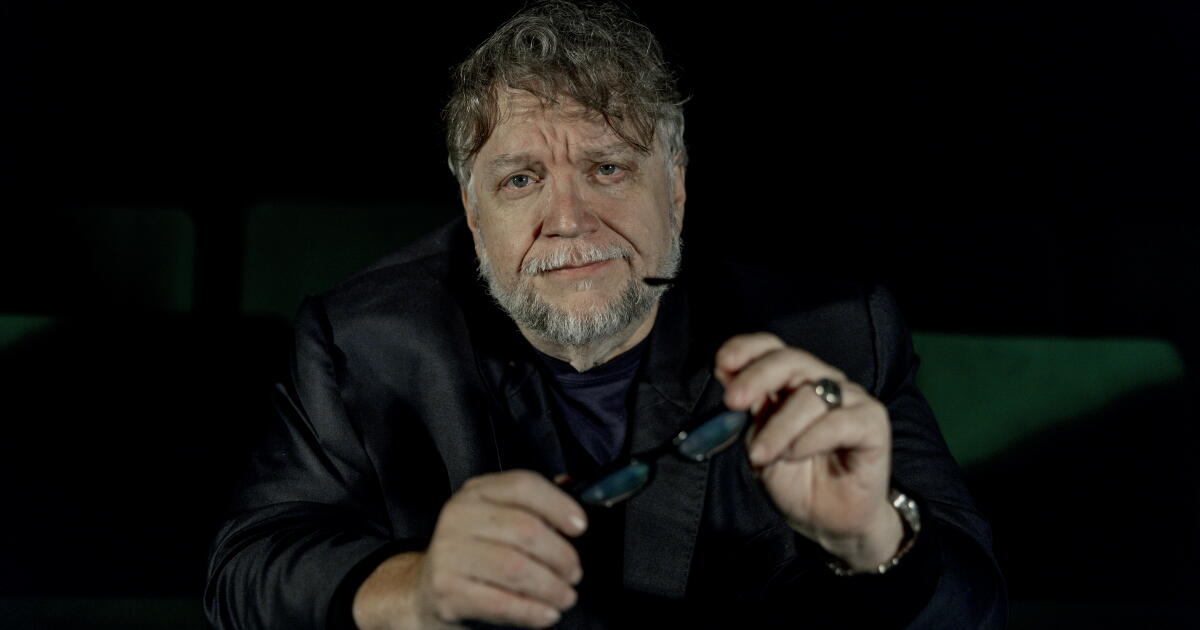
A tiny, distinctly human-like fairy flutters through the ancient remnants of a long-gone kingdom, leading a young heroine to a hidden faun. For a fleeting moment, it seems as if this enchanting creature will leap off the screen. This magical moment brings a chuckle of pride from Guillermo del Toro, who, wearing 3D glasses, sits in the grand David Geffen Theater at the Academy Museum of Motion Pictures, preparing for a tech check. Later that evening, nearly a thousand fans were swept away into the captivating world of his acclaimed 2006 film, Pan’s Labyrinth (originally titled El Laberinto del Fauno), at the launch of its new 3D version.
On Friday, which coincidentally marks Del Toro’s 62nd birthday, Pan’s Labyrinth returns to theaters in celebration of its 20th anniversary, boasting a newly restored version in glorious 4K that is accessible in both 2D and the aforementioned 3D format, personally overseen by Del Toro himself.
A tale that is both brutal and mesmerizing, Del Toro’s modern classic is set against the backdrop of the Spanish Civil War—specifically in 1944—focusing on young Ofelia (played by Ivana Baquero), who, along with her pregnant mother, arrives at a military camp ruled by the tyrannical Captain Vidal (Sergi López). In the midst of turmoil and violence, Ofelia stumbles upon a world filled with magical creatures, including the enchanting faun (played by Doug Jones), who reveals to her that she is a lost princess destined to reclaim her rightful place.
Pan’s Labyrinth garnered three Academy Awards and received nominations for two additional honors: one for Del Toro’s screenplay and another for Best Foreign Language Film, which represented Mexico. This film marked a pivotal turning point in Del Toro’s career, following his previous work on comic-book adaptations like Blade II and Hellboy. The journey to realize Pan’s Labyrinth was spiritually significant for the Guadalajara native, largely due to the obstacles he faced in bringing it to life.
“Pan’s marks a significant shift in my filmmaking journey,” Del Toro shares. “It became something sacred to me; filmmaking transformed into a kind of religion.”
Despite now being regarded as one of the greatest films of the 21st century, Del Toro recalls that the industry was initially unwelcoming to his vision. “Everything I planned to convey about war in The Devil’s Backbone felt outdated in the wake of 9/11 and the world’s shift,” Del Toro reflects. “I aimed to create a companion piece to The Devil’s Backbone, yet nobody wanted to produce it.”
The skepticism was primarily directed at the film’s mature themes, wherein a child protagonist confronts the very real perils that arise from fascist ideologies. Del Toro recalls, “They insisted that if it’s a fairy tale, it must cater to families. I was once approached to adapt Narnia, but I wanted to craft my own version of a fairy tale where the lion doesn’t come back to life, reflecting a grim reality against an unbridled imagination.”
Del Toro’s belief in addressing children’s hardships stemmed from his early viewing of Luis Buñuel’s 1950 classic, Los Olvidados, which depicted neglected children facing brutal realities in Mexico City.
“Seeing Los Olvidados during my teenage years made me realize that stories about children, told without sentimentality and often in a brutal light, deeply resonated with me,” states Del Toro. He understands children to be largely overlooked by adults, often viewed as mere caricatures. He recalls with a whimsical smile how he would read child psychology books to better manipulate his mother, often getting her to procure horror comic books or grant him permission to skip school.
Ofelia’s unwavering strength in Pan’s Labyrinth epitomizes Del Toro’s central narrative desire: to witness a child triumph over a fascist villain.
In a narrative twist, Del Toro’s mother, Guadalupe, passed away in 2022, yet her legacy continues through her role in the groundbreaking queer Mexican film, Doña Herlinda and Her Son.
Del Toro has fond memories from his childhood that formed a significant basis for his storytelling. "For me, the question has always been whether creating films is worthwhile," he admits. "We invest so much time, yet they drift into cultural oblivion. The central theme of Pan’s Labyrinth asks if one can devote their life to something that ultimately doesn’t change the world."
Despite the impermanence of his creations, Del Toro is hopeful. He articulates how the films may take the shape of flowers blooming from barren trees, standing as testaments to their existence in a transient world.
Moreover, Del Toro is staunchly opposed to the influence of generative AI on art creation, advocating for the irreplaceable value of human touch in storytelling. Reflecting on Pan’s Labyrinth, he shares, “It’s profoundly true to who I was. When sincerity radiates from your work, people sense its significance."
As Pan’s Labyrinth returns to cinemas, its bilingual appeal remains an essential part of its marketing strategy, resonating deeply with audiences across cultural boundaries. Del Toro’s aspiration to produce another film in Mexico signifies his commitment to his artistic roots. “I have a story stirring inside me,” he reveals. “It’s a drama centered on a kidnapping incident illustrating three diverse perspectives—a tale I can’t wait to tell."
The enduring strength of Del Toro’s work, and Pan’s Labyrinth specifically, reinforces the idea that art, when crafted with passion and authenticity, can transcend time and human experience, providing solace and reflection to future generations.
Read more about this topic:
‘Pan’s Labyrinth’ at 20: ‘I wanted to see the kid win,’ says Guillermo del Toro


